Showing posts with label Jeffrey Lieber. Show all posts

Tuesday, June 27, 2023

Podcast appearances on The Writers Panel and Children of Tendu

In a complete coincidence I had two podcast appearances drop on the same day this week.

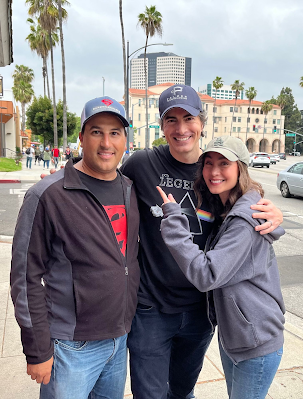
First, my friend Ben Blacker had me on The Writers' Panel to discuss my thoughts on networking on the picket line. We're in the nineth week of picketing and I've met something like fifty writers while picketing. And as I mention in this podcast, I also met Brandon Routh (SUPERMAN RETURNS) and his wife Courtney Ford (LEGENDS OF TOMORROW.)

Listen to The Writers' Panel here.

And then I got to fulfill a nearly decade-long dream by appearing on a podcast hosted by another two of my friends and former co-workers, Javier Grillo-Marxauch and Jose Molina. Their show Children of Tendu is one of the greatest resources for an up-and-coming TV writer and it was an honor to speak with them about my path from internet guy to assistant to staff writer.

The episode I'm on is called "Live from the Strike Line."

Listen to Children of Tendu on Stitcher here.

Listen to Children of Tendu on Apple Podcasts here. 

Listen to Children of Tendu and download the ep as an MP3 here.

Monday, November 4, 2019

Why Hollywood Assistants are mad as hell and not going to take it anymore

So let's have a talk about the realities of being a Writers' Assistant, but not about the demands of the job. If you're interested in those, check out my Writers' Assistant Rules here.

There's a conversation that's recently exploded in Hollywood, an inevitable release of tension that had been building over a year for those who'd been paying attention. The short version: Writers' Assistants and Script Coordinators unionized about two years ago, finally locking in salary rates that made their wages livable... provided certain conditions like a 60-hour a week guarantee applied. Studios, seeing an opportunity to step on the throats of peons who dared to stand up for themselves, started cutting hours and overtime, sending takehome pay back into the Stone Age.

With this resentment building up over the last year, it's not a surprise that John August and Craig Mazin's recent episode of Scriptnotes, "Assistants Aren't Paid Nearly Enough," became a flashpoint for conversation. That conversation exploded on Twitter when writer Liz Alper coined the hastag #PayUpHollywood, which became the center of conversation for how assistants are exploited and underpaid. Many former and current assistants aired their grievances publicly.

For those who didn't want to share their stories openly, Liz provided a like for anonymous submissions. You can find that here.

This weekend, there was tangible proof this conversation was reaching beyond twitter, as the LA Times covered this movement. A choice excerpt:

Hannah Davis, now a script coordinator for the HBO show “Perry Mason,” recalled how during her first job three years ago as a writer’s assistant at a television network, she received a letter from the network’s accountant telling her she had gone over the allotted lunch budget and the overage would be deducted from her paycheck. Davis made $600 a week, and one of her tasks was ordering lunch for the writers room. 

“I was a baby PA and it wasn’t cool to tell a writer, ‘Sorry you want extra salmon; we can’t afford it,” she said. She was lucky: The writers offered to pool together $50 a month to cover any future lunch budget overruns.

Stories like this are not uncommon, but I want to add some elements that no one talks about when you first chase a Writers' Assistant job. I’m going to explain in very clear terms why making assistants scrape for any kind of raise is nothing more than an exercise in power-tripping that doesn’t save any real money. Current union minimum rate for writers’ assistant is $14.57/hr. At 60 hrs a week that’s $1019.90. It’s... livable.

60 hours a week used to be the standard. But like I said earlier, studios are departing from that to punish the unionization. Some approve NOTHING over 50 hours, which makes that rate come out to $728.50/wk That’s a loss of over $300/wk, $1200/month. That’s a rent payment for someone.

But hey the studio saved $300/week. In a 20-week room, that’s $6000 for the entire season!

Do you know how pathetically little $6000 is in terms of a show’s production budget? A STAFF WRITER (the lowest paid writer on staff) on that same show is making $4,170 a WEEK. That’s $83,400 a season.

$6000 saved is SEVEN PERCENT of what the CHEAPEST writer makes.

The next level up is Story Editor, who makes $6,797 a week, or $135,940 a season. So that $6000 saved is 4.4 PERCENT of their salary.

Imagine how small that % gets when I’m comparing it to a showrunner getting script fees on top of their hefty paycheck. Or hell, the non-writing (often non-WORKING) Executive Producer fees. Studios and show accountants are screwing assistants over for comparative PENNIES.

It’s not about saving money. It’s about disrespecting assistant because they can. They’re telling them how little they are valued. Remember that.

OH! Also if they’re messing with your hours it screws your insurance. On your first show, you need 600 hours in a period to qualify for 6 month of coverage, then 400 hours banked/per coverage period after that.

60 hours a week means in 20 weeks you earn 1200 hrs... a year of coverage. 50 hrs a week means you earn 1000. EXACTLY enough for a year, so you’d better not miss ANY hours. (Paid Holidays only pay you 8 hours a day, not 12, so if Labor Day falls in your 20 weeks, you come up 4 hours short.)

And at 40 hrs/week... well you got six months of coverage and another 200 hours banked, so you’d better hustle and get a new gig fast!

There are no compelling reasons to put assistants through this hell by not adhering to a 60-hour guarantee. They do a lot of work and provide invaluable help to the shows they work on. This is not a job where you can plug in just anyone and expect them to thrive. The fact that there are hundreds of people seeking these jobs for every one that gets employed does NOT mean that all of them are capable of doing it.

The main reason assistants put up with this is because there used to be an expectation of an apprenticeship component to these jobs. If you put in your time, you'd get a script and maybe even get staffed in a timely fashion. It wasn't expected you'd sit at the assistant level for nearly a decade before getting your shot, but that's another grievance that's coming to the forefront. Assistants are speaking up about how many of them are dealing with bosses who have no interest in advancing them.

If you want to see an example of a showrunner who really gets it, listen to friend-of-the-blog Jeffrey Lieber. Here's his take on the pace that writers' assistants should be advancing at.


Jeff gets it. If only we had a town full of showrunners like Jeff Lieber, they could really stand up to studios who would be happy to pay assistants with a lump of coal. Then again, with enough pressure, coal becomes a diamond, so let's keep that pressure up.

Monday, January 21, 2019

10 Years of Bitter Posts - Video Interviews with Liz Tigelaar, Franklin Leonard, F. Scott Frazier and Jeffrey Lieber

When I created the Puppet to give me a way to be a little more public, the thing I was most interested in doing was interviews with writers. This shows I hadn't considered two things: 1) how much harder it is to operate a puppet than it looks and 2) most writers HATE going on-camera.

Despite that, I found a few VERY patient writers willing to spend up to an hour talking to a puppet with all the gravity they would give an NPR interview - while also basically assuming ALL the risk of looking ridiculous.

What I'm saying is, Liz Tigelaar is a saint for trusting me enough to be the first one on deck. You might be watching this 13-part interview and wonder, "Is Liz Tigelaar as nice as she seems?" No! She's nicer!

In this conversation with Liz, we trace through how she got her start as a writers' assistant, working as a staff writer, creating Life Unexpected and much, much more.


Equally patient was Franklin Leonard, who sat for two interviews, one about the history of the Black List in general and one announcing the launch of the Black List website.


Speaking of the Black List, multi-Black List writer F. Scott Frazier also endured questions about how he broke in and gave us some insight into being a working feature writer.


And after that I had a fun interview with TV showrunner Jeffrey Lieber. Jeffrey got his start in features, wrote the original pilot that became LOST, and then created MIAMI MEDICAL. After our interview he ran NCIS: NEW ORLEANS and was a Consulting Producer on THE ORIGINALS. If you're on twitter, you probably also know Jeff from his "Showrunner Rules."


Original posts:
Liz Tigelaar interview
Franklin Leonard interview
F. Scott Frazier interview
Jeffrey Lieber interview

Thursday, January 29, 2015

This blog turns six! - There's still much more work to do

Today this blog is six years old. Honestly, I'm kind of surprised it's lasted this long and that so many of you fine people still drop by to read every new post. It's funny to think that when I started it, I wondered if I'd have enough material to keep me going six months.

Some of you have possibly noticed that the blog output has slowed a bit. That's largely due to the fact that I've exhausted a lot of the common topics and questions I could cover related to screenwriting. I've been able to compensate for that over the last few months as it's Oscar Movie season and I've had a full buffet of great movies to discuss.

The other big sea change is that it's become more and more common for people to use Twitter as an output for their musings and advice. I still like the idea of a permanent archive on the blog, partly because it allows new readers to discover those nuggets long after the fact. Even so, I know I've had plenty of times where I've tossed off a good rant on twitter and found that got it enough out of my system that I didn't feel the need to come back here and flesh it out. I'm trying to be better about that.

Ah, Twitter. I really can't believe that I still have yet to plateau in terms of followers. As I write this I have over 27,700 followers and the last time I checked, only a few percent of those were deemed "fake." It's flattering to see evidence that people are still discovering me and interested in what I have to say.

I bring this up because even more than through this blog, I've made a lot of great friends and contacts through Twitter over the last six years. It's absolutely been one of the best things I could have done for my career. I've made some good friends, including fellow aspiring writers, actors, and working writers - including a showrunner or two. I definitely recommend trying to build your own social network. It takes time but if you use Twitter right, you might find a few doors opening up for you.

As it's Awards Season, it feels appropriate to conclude this look back with a few thank yous.  There's not enough space here to acknowledge everyone whom I've met and become friends with due to this blog, but there are a few in particular I want to call out.

I did my best to put this list in random order, but I have to start with Scott Myers. About five months into the life of this blog, Scott was the one who really put me on the map when he featured me and gave me a very generous plug on the only must-read screenwriting blog, Go Into The Story. For almost five years, my relationship with Scott was completely through emails and tweets. I met him just over a year ago and it was a genuine delight to find he was everything you'd expect. Scott is the screenwriting professor I wish I'd had in college, running the sort of blog I could only dream of reading when I was taking my first steps into screenwriting. As I implore you often, please visit Go Into The Story regularly.

Hollywood has a reputation for having a lot of assholes. Some of that is earned, but my first-hand experience has been that there are a significant number of sincerely giving people. Over the years, a very high percentage of the working writers I have met have been some of the kindest, most helpful people out there. There's this myth that working writers are out to screw over aspirings. I've never seen any evidence of this, and the people I'm about to name-check are the furthest from that:

Eric Heisserer was one of the first working writers whom I got to know through Twitter, following his reaction to a tweet about the NIGHTMARE ON ELM STREET reboot. He later consented to an interview about the film and also authored a guest post about the life of a script in the studio development process. Even today, that post stands as my third-most-popular post of all time. On a one-on-one level, Eric has also been giving enough of his time to read some of my work and offer help where he could. He didn't do it so I'd blog about it, he's just that kind of person. Publicly he's very giving in offering the occasional screenwriting knowledge drops on Twitter, and I encourage you to follow him for his regular insights.

If you just know John Gary from Twitter, you probably have this image of him as the cranky pessimist who's the first one to say why the latest screenwriting development is a half-empty glass. But you'll have to look hard to find a more passionate advocate for writers, and someone more determined to make sure that naive aspirings aren't taken advantage of by charlatans and scams. He also regularly takes on what he calls The Hope Machine - the parent of the pie-in-the-sky fantasies that writers have about how easy it'll be to gain fame and forture from their writing. John doesn't tell you want you want to hear - he says what you NEED to hear. Like me he's seen the business from the inside as both a reader and a writer, and you would ignore the wisdom from that experience at your peril.

Along the same lines, I consider Geoff LaTulippe a must-follow. You can never accuse Geoff of not speaking his mind and while his blunt and aggressive nature sometimes gets him into trouble, he's very open to answering questions from aspiring writers on Twitter, on his podcast Broken Projector and on his personal website. If memory serves, Geoff might have been the first pro writer to reach out to me with an offer to read my script, and I know that's a courtesy he's extended to a few, perhaps many, others.

Justin Marks is a working writer who I first came to know via Twitter. We seem to approach things from a similar point of view and it's rare that there's a significant gulf in our opinions. (Justin once quipped that "we could pilot a Jaeger together.") I finally met him last year and it was a relief to learn that our rapport extended to our face-to-face interaction. Justin's got two big projects in the future: The Jon Favreau-directed Jungle Book movie coming in 2016 and the sequel to Top Gun, still unscheduled as far as I know. He's another one whose tweets can be a good insight into the business, so give him a follow.

F. Scott Frazier was one of the first writers to reach out to me to meet in person, and I'm glad I dropped the mask to do so. Scott tends to do his good deeds without advertising them, but I know he's gone out of his way to be a mentor to some writers. Like many others I know, he definitely believes in paying it forward, and frankly, he's prolific enough that it would be understandable if he didn't want to take the time to do so. I'd be remiss if I didn't plug my interview with him.

When people come to me asking for a coverage referral, I point them at Amanda Pendolino and ONLY Amanda Pendolino. Like me, Amanda's gotten a number of years as a script reader under her belt while trying to build her own career. She gives really sharp notes, and in a manner that always feels constructive. I recently gave her a script that I'm pretty sure wasn't her cup of tea, but she made a passionate, persuasive case for her opinions without making me feel like I'd been eviscerated. That's rare. On top of that, she's a great writer who deserves to be on staff somewhere. I know if I was a showrunner, she'd be one of my early draft picks.

Speaking of showrunners, Jeff Lieber is another favorite twitter-buddy. Currently one of the showrunners on NCIS: New Orleans, Jeff is one of the creators of Lost, as well as the creator of Miami Medical and was a showrunner on Necessary Roughness. He's used those assignments and others as fodder for his Showrunner Rules, which he regularly doles out on Twitter. You can find the whole archive here and his feed is always a valuable read.

The people I've named already are all great writers, but one writer whose work just knocked me on my ass was Brian Scully. I gave a spotlight post to his brilliant script MERCIFUL last year and soon after that, Brian landed management with Verve. I'm currently in the weeds on a very dark script of my own and I can honestly say that MERCIFUL has been like that rabbit they use to get the greyhounds to do laps around the track. I've read plenty of scripts that have inspired me and taught me, but MERCIFUL is one that really pushed me to be better and to not be scared to take chances.

Through my association with Go Into The Story, I also came to know Nate Winslow. Scott Myers calls him "future super producer Nate Winslow" and not without good reason. Nate is a savvy guy who's worked on a number of film projects, most recently at Defender Entertainment. If someone's smart, they'll snap him up to be their Creative Executive because he's got a great eye for projects. There are some people who you can just tell when you meet them that they have what it takes to make their own good fortune. With Nate, I know it's only a matter of time before he puts together a project and becomes one of those guys everyone is trying to get their scripts to. He's another one who keeps me motivated, if only so I don't feel like I'm standing still next to him.

And last, but certainly far from least, I consider myself fortunate to have gotten to know Black List founder Franklin Leonard. I take a very dim view of most services that ask screenwriters to pay for them. I don't typically trust coverage companies because you can't really trust who's reading those scripts, and it's rare to find such a company where the person in charge has a significant amount of credibility to put on the line. When Franklin told me he was expanding the Black List's mission to including hosting and review services for aspiring writers, I was skeptical. After he laid it out for me, I became a believer.  A few half-wits have accused my endorsement of the site of being the back-scratch that was redeemed by payola. I can assure you I have no official affiliation with the site, nor have I ever taken any sort of money, bribery or whatever you want to call it. I endorse the Black List because I believe in it and in what Franklin Leonard is trying to do.

I've been fortunate to meet many successful people. I've worked for a number of industry pros who were very good at their jobs and have been able to produce films for most of their adult lives. I want to tell you what sets Franklin Leonard apart from them. Those men and women are very adept players within the existing system. Franklin Leonard is a guy with the will and the forethought to change the system. The Black List is constantly evolving and expanding, carving out partnerships with management companies, studios and producers. More than that, Franklin is possibly one of the most above-board and intelligent people I've met out here. There's nothing phony about him, and if we had more Franklin Leonards, that wouldn't be a terrible thing for our industry.

Franklin is smart enough he could probably be very successful just playing the game as it is. Instead he's forging his own path. I'm glad that writers - both aspiring and professional - have such a driven advocate. I know he's going to continue to push to make the Black List better. I once said to him that he must be proud of everything The Black List has become and his reply was, "There's still much more work to do."

Those who succeed are often those who are rarely satisfied.

These people I have named all have a few things in common. In one way or another they have all provided support and inspiration, and I've been lucky to get to know them. And there are still plenty more whom I don't have the space to name here. I also would never have met ANY of them, had I not started this blog six years ago and stuck with it even when I was getting only 50 hits a day the first few months. I would be a poorer individual for not knowing them.

If you have good fortune, pay it forward. When you deal with others, know there's little to be gained from being a dick. When you reach a goal, start formulating the next one, pushing yourself even harder than you did before. Most of all, don't let yourself become too satisfied with whatever you accomplish.

Thank you all for six great years. There's still much more work to do.
Friday, October 25, 2013

Interview with film and TV writer Jeffrey Lieber - Part 6: The Bitter Questions

Parts 1 and 2 - How did you get an agent? and First sales and going into TV.
Part 3 - The early genesis of Lost
Part 4 - The process of developing a show
Part 5 - Cable TV vs. Network TV

Our week-long interview with Jeff Lieber (Lost, Miami Medical, Tuck Everlasting, Crash and Burn) concludes as Jeff takes his turn in the hot seat with "The Bitter Questions."  Learn what Jeff considers his proudest and his most self-indulgent moments in writing, among others.


And if you're curious about how other writers handled the same questions, check out this handy playlist that houses all of those segments.

Thursday, October 24, 2013

Interview with film and TV writer Jeffrey Lieber - Part 5: Cable TV vs. Network TV

Parts 1 and 2 - How did you get an agent? and First sales and going into TV.
Part 3 - The early genesis of Lost
Part 4 - The process of developing a show

Our talk with writer Jeff Lieber (Lost, Miami Medical, Tuck Everlasting) continues.  In this segment, Jeff talks the difference between developing a show for network TV vs. cable networks.  He also discuses how he goes about developing a show that draws on real life events and people versus shows with more fantastical elements.


Find Jeff on Twitter at @JeffLieber.

Part 6 - The Bitter Questions 

Wednesday, October 23, 2013

Tuesday, October 22, 2013

Interview with film and TV writer Jeffrey Lieber - Part 3: The early genesis of Lost

Parts 1 and 2 - How did you get an agent? and First sales and going into TV.

If you look up Jeff Lieber's credits, it will probably leap out at you that he's credited as a co-creator of Lost.  However, not only did Jeff never write for the series, he never worked with fellow co-creators J.J. Abrams and Damon Lindelof. So what was Jeff's role in the genesis of the series?  What did his version of the Lost pilot contain?  Click on the video for the answers.


Find Jeff on Twitter.

Part 4 - The process of developing a show
Part 5 - Cable TV vs. Network TV
Part 6 - The Bitter Questions 

Monday, October 21, 2013

Interview with film and TV writer Jeffrey Lieber - Part 1 & 2: "How did you get an agent?"

This week, it is my honor to be interviewing Jeffrey Lieber, a writer who's been very active in both film and television.  To some of you, his name might be most familiar as a co-creator of Lost.  Others of you might know him as the writer of the film adaptation of Tuck Everlasting.  For many years now, Jeff has been a working TV writer.  In addition to creating Miami Medical, he's also worked on The Whole Truth, Chase, Pan Am and Necessary Roughness.  His latest project is an FX drama called Crash and Burn, which is centered on the lives of stuntmen in the pre-CGI era of filmmaking.

Jeff is also known around the blogsphere for his list of 200 "Showrunner Rules," which are handily archived here thanks to fellow blog warrior Scott Myers of Go Into The Story.

And don't forget to follow Jeff on Twitter.

In our first segment, I dive right in and ask Jeff how he got his first agent.


In our second segment, Jeff discusses his first script sale, his first produced film, and his shift from features into television.


Come back every day this week for the remaining parts of the interview!

Part 3 - The early genesis of Lost 
Part 4 - The process of developing a show
Part 5 - Cable TV vs. Network TV
Part 6 - The Bitter Questions